Boosting employee engagement is crucial for any business that wants to achieve success and retain a motivated and committed workforce. Whether your organisation has always been remote-first or the pandemic shifted your team to work-from-home or hybrid working, keeping your employees engaged and connected is key to achieving business goals. By implementing strategies that promote engagement, you can improve productivity, create a positive work culture and drive better outcomes.
‘Effective employee engagement’ isn’t just a buzzword.
Your people can make or break your business
Every employer wants their people to be able to do their best work, to enthusiastically contribute to the business’s success and to be committed employees that help to achieve company goals.
And every employee wants to feel proud to come to work every day and be valued (and rewarded) for the physical and emotional investment they bring to the workplace.
No matter the role they hold, your people want to know that they are an important part of making your company successful.
They need to know their purpose.
With effective communication comes productive and meaningful relationships, and without those flourishing within your teams, your work culture and your overall business may not be as healthy as it seems.
In this article, we look at why listening to your people (and we mean really listening) is one of the most valuable things you can do for your teams and for your business. We also share what employee engagement looks like here at Scede.
Short on time? 🕒
5 techniques to build an effective employee engagement strategy
Jump straight to ‘Employee engagement at Scede – how and why we listen to our people’.

First off, how do you describe employee engagement?
Employee engagement is essentially the mental and emotional commitment an employee has to your organisation and its business goals. Don’t confuse this with employee satisfaction, which is simply how pleased someone is at work or in their role; we’re talking about in-depth, honest, two-way (business) relationship goals here.
Here’s a simple example:
Q – Are you in a happy relationship?
A – Yes, I am in a happy relationship.
This is satisfaction.
Q – Are you in a happy relationship?
A – Yes, I am happy in my relationship, I strive every day to keep it so and continuously work to make it even better.
This is engagement.
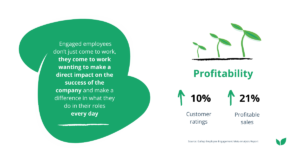
There’s a big difference, and it’s not hard to see which camp you’d like your employees to fall into, right? Engagement requires action. Engaged employees don’t just come to work, they come to work wanting to make a direct impact on the success of the company and make a difference in what they do in their roles every day.
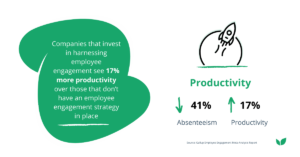
Increased productivity & reduced absenteeism
According to Gallup’s Employee Engagement Meta-Analysis Report, companies that invest in harnessing employee engagement see 17% more productivity over those that don’t have an employee engagement strategy in place.
They also experience a massive 41% less staff absenteeism in the workplace. While there are always various reasons for team members being absent, the report shows a lack of interest or engagement in the workplace contributes heavily to this number.
Let’s be honest. As much as you’d like your people to love your company, brand, organisation or initiative as much as you do, chances are that without incentive or ulterior emotional investment, they just won’t.
Facilitating two-way communication with your employees and empowering them to share their input, opinions and feedback (not just their skills), should create a healthy dynamic for the business and workplace culture.
Why collecting employee feedback REALLY matters
To give the best employee experience, you have to understand why collecting employee feedback really matters, and how to capture it. We know that engaged employees are more connected to their workplaces – right from the day-to-day tasks of interacting with their colleagues and clients, through to the wider company vision and goals.
They notice what goes on around them and they care about it.
Collecting their feedback, observations and ideas and acting upon them is the key to maintaining that engagement, and ultimately, to retaining the talented people you’ve hired.
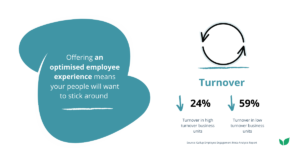
A harmonious workplace utopia that no one will ever want to leave just doesn’t exist. People move on to pastures new, and that’s inevitable. But by collecting honest, genuine, real-time employee feedback, you can build a culture of true engagement and give your people the voice they not only want but deserve.
Remember, seeking engaged employees isn’t about how to squeeze more out of them.
It’s about building an organisation where people really want to work – where they feel valued, listened to and invested in, and as a result, want to stick around.
5 techniques to build an effective employee engagement strategy
No two employee engagement strategies will be the same – every company has its own requirements, and it’s important to remember that your approach will only be effective if it’s created around the needs of your people and business as a whole.
To define the crucial elements of what makes a successful workplace experience, you first have to find out what is and isn’t working within the company and to do that, you’re going to need to talk to your people.
Using employee engagement tools
This is where using employee engagement tools comes in. These allow you to create customised surveys to capture honest, anonymous feedback, meaning your teams are free to express their opinions and share concerns without censorship.
There are many drivers that influence employee engagement, such as recognition, growth opportunities, management support, peer relationships and environment.
Below, we’ve shared some touchpoints that we’ve thought about here at Scede, and that you might like to consider when building your own employee engagement strategies.
1. Prioritise your team’s physical and mental wellbeing
Normalise prioritising mental health, and empower people to take time out if they need to. Provide access to, or subsidise physical and wellness initiatives, apps or programmes. Find ways to support your team to be the best version of themselves – whether through a monthly allowance, offering “me” days, or holding workshops – because people value being part of compassionate and inclusive businesses.
2. Communicate your core company values and live by them
Employees are more engaged when the core values of the organisation align with their own. Demonstrate that your values are the foundation of your workplace culture and make sure they’re visible in your communication and day-to-day working.
Create rituals that reinforce the behaviours aligned to your values, like using emojis on team channels in Slack or Teams to recognise value-driven work, and giving quarterly awards to celebrate individuals who are living by them.
3. Give your people growth opportunities
Create and communicate a clear, transparent growth structure and role opportunities for your employees. They want to see what could come next in their development and how they fit into the company’s future. If they can’t see it, it’s tough to envision it happening – so having this easily accessible to all is important.
4. Recognise achievement and do it publicly
Energise your team by celebrating achievements both from teams and individually. And don’t just focus on typical measures of “high performance” – recognise things like continuous improvement, going above and beyond, successful projects or new ideas.
People want to feel valued for their hard work in more ways than a monthly paycheck. Something we’ve introduced at Scede is a peer-to-peer recognition programme, which empowers our team to recognise, celebrate, and thank one another daily.
5. Show employees you’re listening and they’re being heard
All of the above points are completely moot if you’re not taking action from the feedback you’re being given from your people. If no solutions, discussions or proposed changes happen when employee feedback is given, they’ll become disengaged – meaning less insight for you.
Where possible, respond to comments personally – good and bad – to give your teams the confidence that their feedback is being listened to.
Employee engagement at Scede – how and why we listen closely to our people
Before Scede was even a scede-ling (…we couldn’t resist!) our Founder and CEO, Matt Ellis, saw a huge disconnect in how decisions were made in some companies.
People in leadership positions often made decisions for the business that were out of touch with their employees. Initiatives were rolled out without context or communication with the wider organisation. A lack of transparency meant employees weren’t able to see how they contributed to the overarching business goals, and what the decisions being made meant for them.
Fast-forward to Matt founding his own company: Scede – an embedded talent partner for fast-growing startups and scaleup companies.
Matt knew he had the opportunity to do things differently and build a more inclusive business with clear DE&I strategies and healthy work culture where everybody is empowered, irrespective of role or level. Matt is now passionate about the fact that “individual responsibility is one of Scede’s core values as a business, and part of that is making sure that everybody has a voice”. One way that this is enabled at Scede, is through our employee engagement platform.
So why do we use an employee engagement tool at Scede?
As tends to be the case for many Founders, Matt was still working “in” the business before adopting an employee engagement tool.
With around 10 to 20 people on the team, he could have regular, candid conversations with everyone and get a first-hand feel for what was and wasn’t working. He was able to act on feedback purely from having those one-to-one conversations and take action as and when needed.
As the business grew and became more geographically distributed, Matt wanted to maintain a mechanism for gathering the feedback and insights he had been getting from his people.
Obviously, one-to-ones with 50+ employees simply isn’t feasible – especially as a CEO. So he wanted to find a solution that enabled everyone to have a voice and kept communication lines open.
The ethos at Scede is to “build the business together” – everyone has the power to shape the company’s journey, which is why keeping that channel of communication available was vital. That’s where using an engagement platform came in.
Milestones were made by collecting employee feedback
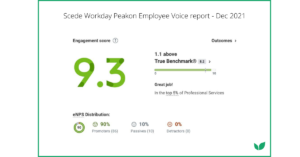
In 2018, Scede started using an employee feedback platform; Workday Peakon Employee Voice. At the end of December 2021, we achieved our highest ever engagement score: 9.3 (out of 10). This is 1.1 above the “True Benchmark” score for professional services (8.2). We also had a high 95% aggregated participation score for the year, which is 8 percentage points above the professional services benchmark of 87%.
You can read more on how benchmarking works here.
This doesn’t happen by accident, especially during a pandemic where employee engagement and job satisfaction have been decreasing globally. We’re always the first to admit we’re not perfect. But these results reflect the very conscious effort we’ve committed to driving positive employee engagement, and our continuous work to improve this as we scale.
Here’s a closer look
Within Workday Peakon Employee Voice, there are “highlighted drivers of engagement”. These drivers measure how satisfied employees are with the culture, leadership, and responsibilities that make up their experience at work.
By having a data-led view on aspects of the business as well as a commentary from employees, key drivers in the business can be aligned with your core values or mission.
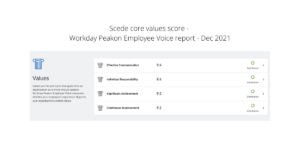
At Scede we also measure how aligned to our values our employees feel. The image below shows you on a scale of 0 – 10, where we’re sitting against our four core values; Effective Communication, Individual Responsibility, Significant Achievement, and Continuous Improvement.
From employee feedback to action: Making employee voice a priority
Big changes were driven as a direct result of collecting employee feedback at Scede. Perhaps the most notable of these was the decision to revisit our operating model.
Formerly, one individual at Scede might be working across multiple clients at one time – which can be hard to keep up with. So that we could balance both the delivery of exceptional service and the quality of employee experience and role fulfilment, we changed this.
Now, Scede Talent Partners become dedicated in-house recruiters for one client for a set period of time – typically 6 to 12 months.
Another change driven by employee feedback was developing a career progression framework.
By studying the survey data, we uncovered that people wanted to see a more detailed view of how they could progress within the organisation. Employees recognised there were progression opportunities at Scede, but actually how to progress from role to role was unclear. Our new progression framework is now clear and available for all to see at any time on our company’s Notion platform.
More recently, we also revised the benefits that we offer our employees. Benefits were highlighted as a priority topic within Workday Peakon Employee Voice, having been mentioned by our team multiple times.
Following a review of the data and focus group feedback, we recognised that everyone on our team is brilliantly unique – with different priorities, needs, and motivations. As such, we created a set of benefits that gave them the flexibility to choose those that best suit them. This is something we’ll share more on over the coming months, so watch this space!
Continuous improvement comes from honest feedback
Despite receiving high scores, it’s not always plain sailing when reviewing data from employee feedback surveys. Matt mentions that receiving negative feedback has perhaps been the most beneficial thing to him as a leader, as it tells him where he needs to focus. If everything’s good, it can be unclear on where to improve, with no visible areas to direct his attention to.
“Negative feedback has perhaps been even more beneficial to me as a leader as it tells me where I really need to focus.” Matt Ellis, CEO, Scede
Matt candidly shares, “I won’t lie, having to detach my own personal feelings is probably the hardest part of collecting employee feedback. This can be really difficult when you’re a Founder-led business and care so much about your team”.
“It can be easy to be reactive when it comes to feedback. But for me, it’s important to use a data-led approach when listening to it – to establish both the nature and scale of the concerns raised. This is vital when it comes to prioritising issues to address, and making sure we respond appropriately.” Matt Ellis, CEO, Scede
Collecting employee feedback shouldn’t be a “vanity project” so that you can shout about how good your business is, or how healthy you think your work culture might be. It’s certainly not a checkbox exercise. There will be ups and downs, and to meet employee expectations you need to actively listen and understand your people better. This is the only way you’ll find out how your employees feel and what they really need as you scale.
Read more on how to respond to negative feedback in this article from the team at BambooHR.
Here’s why our recruiters at Scede love working in an embedded talent environment.
Employee voice and why it’s essential – Scede’rs share their thoughts
“Employee voice” is making sure that people working in a business can express what they feel is important, without judgement or bias.
We asked some of our Scede’rs what they thought about giving their feedback in our bi-monthly employee engagement survey. Here’s Jonjo, Celine, Anna-Lena and Oliver to tell you more.
In your own words, why do you think giving feedback is valuable?
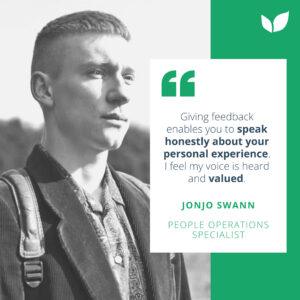
Jonjo – People Operations Specialist
“Giving feedback enables you to speak honestly about your personal experience. I feel my voice is heard and valued. It’s a very useful tool to make sure our operations align with our values as a business and makes sure we are performing to a high standard.”
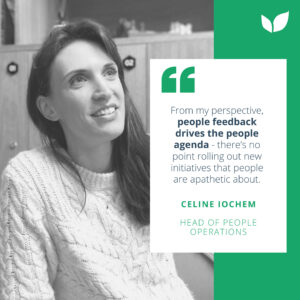
Celine – Head of People Operations
“From my perspective, people feedback drives the people agenda – there’s no point rolling out new initiatives that people are apathetic about. It’s also a mark of respect between leadership and drives a collaborative environment.”
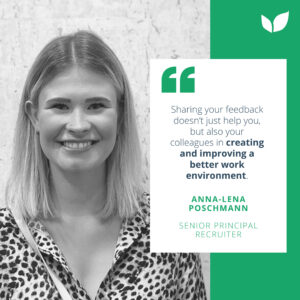
Anna-Lena – Senior Principal Recruiter
“I like giving feedback because I feel I’ve been listened to. I know that the leadership team takes all comments seriously. Sharing your feedback doesn’t just help you, but also your colleagues in creating and improving a better work environment. Our leadership team is aware that there is always room for improvement and wants everyone to have an impact in the growth of Scede’s journey.”
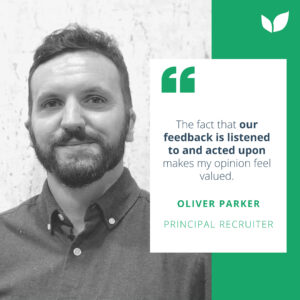
Oliver – Principal Recruiter
“For me, being able to provide direct feedback to Scede feeds right into our value of continuous improvement which doesn’t just pertain to us as employees, but to the company overall. The fact that our feedback is listened to and acted upon makes my opinion feel valued.”
Key takeaway…
Empower your people to have a voice, and they’ll tell you exactly what you need to hear. By listening to your people you can make better decisions to drive meaningful change in your company – creating a healthy work culture, amplifying employee retention, increasing productivity and overall business performance.
But most of all, you can build a business where people really love to work.
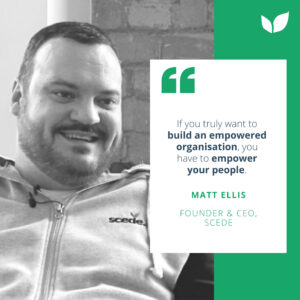
“If you truly want to build an empowered organisation, you have to empower your people” – Matt Ellis, Founder and CEO, Scede